

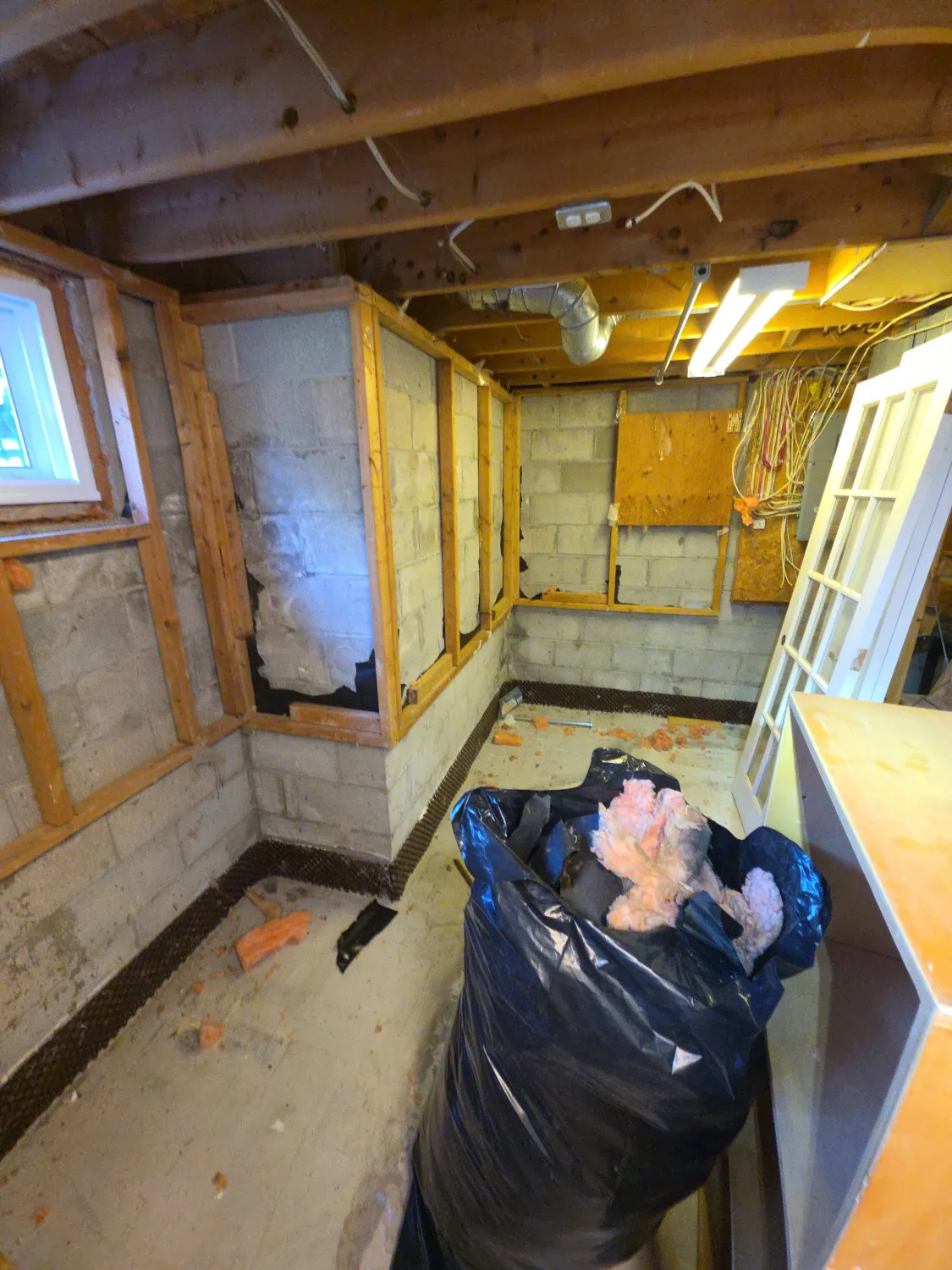
I'm writing this standing in the torn-apart basement of one of my rentals. Bare block walls, a bag of ripped-out insulation, wires hanging from the joists. So renovations are very much on my mind this week.
There are two things I want to get into: the math people get wrong when deciding whether to renovate before selling, and what actually happens once the work begins.
The math that surprises sellers
Here's the trap. You get a quote, say $20,000 to deal with the obvious stuff, and you assume that selling as-is just means knocking that $20,000 off the price. It rarely works that way. A $20,000 job can come off your sale price as $40,000, $50,000, even more. Or the place just sits.
Why the gap is bigger than the quote:
- Your buyer pool shrinks. Most buyers can't or won't take on the work. Fewer interested people means less competition and softer offers.
- Buyers overestimate the cost in their heads. They see "project" and mentally subtract far more than the real number, plus a cushion for everything they're afraid they'll find.
- They want to be paid for the hassle. A discount for the cost, and another discount on top for the disruption and risk of taking it on.
- It shows badly. Rough spaces photograph poorly, so you get fewer showings and weaker first impressions.
- Financing can get harder. A property in rough shape can complicate the appraisal and the buyer's mortgage.
A buyer doesn't subtract what the work costs. They subtract what they're afraid it costs, plus a reward for dealing with it.
So should you renovate before selling?
Honestly, it depends, and this is where I earn my keep walking through it with people.
Some things are easy calls. Fresh paint and worn-out carpet should almost always go. They're cheap, they're universal, and they change how the whole place feels and photographs.
Beyond that, it gets questionable fast. A new kitchen or bathroom? Maybe. Maybe not. If the kitchen is functional and in good repair but just dated, updating it can actually be risky. And here's the part people miss: the moment you put in a shiny new kitchen, it quietly demands that the rest of the house match it. Suddenly the floors and the bathrooms look tired next to it, and you're in deeper than you planned.
That's the conversation worth having before you spend a dollar: what's the real upside, and what does it commit you to.
Renovations have their own momentum
Which brings me to the basement I'm standing in.
It started small. We painted. Then the carpet looked even worse against the fresh paint, so we pulled it and went to hard-surface flooring. Once that was in, the musty old basement room couldn't be ignored anymore. So here we are, down to the block.
That's the thing nobody warns you about. A reno is a chain reaction. Every "maybe, maybe not" item tips firmly into the "do it" column the second the first project is done, because now everything else looks unfinished by comparison.
I'll be straight with you: my budget on this one actually held up reasonably well. But that's the exception, not the rule. In general, renovations take longer than you expect and cost more than you planned. Build in the cushion, and assume the box, once opened, wants to stay open.
If you're weighing whether to renovate before you list, that's exactly the kind of thing I love to think through with people before anyone swings a hammer. Get in touch and we'll work out what's actually worth doing for your place and what isn't.